Friday, 7 September 2018

Incredibles 2

Incredibles 2 from Pixar, was a must-see movie at this year's Edinburgh International Film Festival. Or at least, it was for me. 

The misunderstood supers are back in a sequel in which Jack-Jack shifts towards centre stage, much like the Minions who increasingly stole the spotlight in the Despicable Me series. This time, it’s Bob, aka Mr Incredible, balefully voiced by Craig T Nelson, who’s left holding the baby while his altogether more glamorous partner Helen, aka Elastigirl is out fighting crime. She has been enlisted by a shiny-suited PR guru to help rehabilitate outlawed superheroes via a charm offensive involving runaway trains, political lobbying and a new bike, the Elasticycle.

Back at home, Bob is facing his own challenges: helping Dash with his maths homework, nursing Violet through the traumas of her first teen crush and containing Jack-Jack’s emerging powers, which are as scary as those showcased by the monstrous child in that notorious Twilight Zone episode It’s a Good Life. These include multiplication, transformation, immolation, laser-beam eyes and a Poltergeist-style ability to disappear into the fourth dimension. Oh, and he still needs his nappy changing.

The first Incredibles is arguably amongst the best Pixar films, which is saying a lot. It has heart, humour, depth, and it’s a better superhero flick than some of Marvel or DC's recent outputs. Incredibles 2 – while not as good as its predecessor – also has these qualities. Everything you and I loved about the first film is there. With its fab future-retro designs accompanied by Michael Giacchino’s Bond-inflected score, Incredibles 2 has snappy charm to spare. We’ve seen many of the visual gags before but that doesn’t make them any less effective. Elastigirl is stretched to breaking point several times in the first few minutes alone without wearing down our patience. Dash is shown more than once fiddling with remote controls and causing havoc as he does so. The family dynamic is what makes the Incredibles series special, and seeing Mr. Incredible at home with the kids far exceeds following Elastigirl on her adventure (though that’s fun too). It feels real and allows you to connect with this fictional family of supers. Watching them interact is still so relatable and funny.

And on top of all the fun, director Brad Bird inserts a powerful message. Whereas the first film was all about celebrating what makes you special, this sequel is more about trust. It’s about helping others, and both trusting and allowing others to help you, instead of everyone just looking out for themselves. It very much plays off of the fear and paranoia plaguing our society today. There’s even a line early on in the film about how the government doesn’t trust people who do good just because it’s the right thing to do. It’s very relevant, and a good lesson for both kids and adults in the audience.

However, the voice acting in Incredibles 2 does take a step down from the last film. It’s not bad; most of it is actually pretty good. But there are a few scenes where the actors just don’t seem to jive together like last time. In fact, at times it feels as though the lines were recorded separately and just mixed together. Which very well could have been the case, and is a common practice in animation. It doesn’t always flow properly here though, and can be a little distracting.

Overall, Incredibles 2 did not disappoint after 14 years of waiting. Though it doesn’t quite match the first film, it’s still a worthy successor and a rewatchable Pixar modern classic.

Friday, 31 August 2018

Downsizing

Alexander Payne's social satire Downsizing is one of those films whose premise sounds extremely interesting but isn't effectively explored to any compelling extent. It's an ambitious concept, but it comes off jumbled and confused, failing to grapple with the many themes it tries to juggle. Some of it manages to stick (as things tend to do when you throw a bunch of ideas at a wall), and the film manages to tread some very unexpected terrain, yet still manages to be a long, tedious, seldom gratifying drag.

When scientists discover how to shrink humans to five inches tall as a solution to over-population, Paul, played by Matt Damon, and his wife Audrey, Kristen Wiig, decide to abandon their stressed lives in order to live in wealth and splendor at the acclaimed downsizing resort, Leisureland. However, the decision to downsize doesn't prove to be the salvation that Paul was expecting. 

As far as Alexander Payne satires go, which are generally fairly pointed, Downsizing is as dull as he's ever been. All of the film's lackluster stems form the half-baked and fairly directionless screenplay full of soft and doughy concepts that are never given an opportunity to truly rise. Payne never chooses a side to stand on concerning the environmental issues central to the film, which would've likely worked to the film's benefit. Instead, it tries to straddle this odd bipartisan line; on one hand, it's saying that we should be more globally conscious, and on the other, it's saying that the planet is already too far gone and any efforts to mend it are essentially fruitless. It tries to come off as a think-piece, but its central message (if it even has one) becomes increasingly more and more unclear as the film meanders on. 

The film may've worked better as an ensemble film, but the known names it manages to cram in (like Kirsten Wiig, Jason Sedeikis, Laura Dern, Neil Patrick Harris, and James Van Der Beek) aren't around for much more than a bat of an eye. Narratively, we're stuck with Matt Damon's vanilla everyman character, who never manages to be anything more than boring, for the entirety of the film. Luckily, Christoph Waltz and Udo Kier have much bigger roles than the rest of the cameo performers, and they really help to give the film some redeeming quality.

The series of unexpected narrative and tonal shifts the film undertakes can very easily throw a viewer out of the story. The biggest of these are with Kirsten Wiig, who isn't in the film as much as trailer and synopsis suggest, and with Hong Chau, who plays Vietnamese refugee Ngoc Lan Tran. Both of these shifts are vital to a viewer's potential enjoyment. If you're unable to get behind the film after Wiig's short exit or Chau's bizarre accent and character rendering, the film may irritate the hell out of you. I was fine with Wiig not being a more permanent fixture in the story, but I teeter-tottered back and forth on Chau's performance. Her portrayal of the character didn't really work for me, but her performances did lead to a few laughs, which the film desperately needed more of. The film tried to cover too much ground and got lost somewhere along its journey to find an ending. The unforeseen narrative turns or the amount of ideas the film flings out may be enough for some viewers, but I personally found its lack of focus and convoluted central message to be extremely frustrating. It left me with a lot of questions.

All things considered, Downsizing is not a total disaster. There are some interesting concepts that are halfway explored in the film, a handful of genuinely comical happenings, and some decent cinematography, particularly in the Norway portion of the film; however, it's too all over the place to warrant a recommendation. If you're curious about the film, watch it for free or on demand — you're less likely to feel cheated or disappointed.

Saturday, 18 August 2018

Jumanji: Welcome to the Jungle

Hollywood is always looking for old properties with nostalgia value. It seems they are always looking to take a new approach to something that has a built-in fanbase, and director Jake Kasdan is just the latest filmmaker tasked with doing exactly that, with his revamped reimagining of 1995's Jumanji, now subtitled Welcome to the Jungle.

In this version of Jumanji, we follow four high school kids who, over the course of their day and for one reason or another, find themselves sent to detention. The Geek, Spencer, and the Jock, Fridge, are former best friends who get in trouble because Fridge had Spencer do his homework. The Outcast, Martha, refused to participate in gym class and talked back to the teacher. Finally, there's the Princess, Bethany, who refused to turn off her phone during a quiz. While in detention, they come across a decades-old video game called Jumanji, and as they begin to play, they are transported into the world of the game and transformed into their avatars within it.

Spencer becomes archaeologist Dr. Smolder Bravestone (Dwayne Johnson), Fridge becomes zoologist Franklin "Moose" Finbar (Kevin Hart), Martha becomes "killer of men" Ruby Roundhouse (Karen Gillan) and Bethany becomes a middle-aged male scientist named Professor Sheldon "Shelly" Oberon (Jack Black). Despite their differences, all of them must learn to work together to navigate their way through the dangers of the jungle and to complete a mission to lift a curse on it, so that they can return back home.


The result has elements of an action movie, a body-swap comedy and a video game movie. Yet the film is able to bring the best out of all of these elements, which is a credit to the tremendous cast that has been assembled. A geek trapped in the physique of a bodybuilder is a hilarious concept, and Johnson does a terrific job with it. Likewise, Gillan does a great job cause pulling off her fight scenes while simultaneously hating the impracticality of her outfit, and Hart does a really good job playing the sidekick to Johnson's character, transforming from jock to vertically-challenged in tremendous fashion. But the heart of the film is seriously Black, whose character is so fun-loving and goofy, and who also has a great arc as he comes to terms with how he has been treating others.

Needless to say, Hollywood has a troubled past when it comes to making good video game movies, so it is interesting to see Welcome to the Jungle take this type of approach. The film makes good uses of such gaming concepts as life bars, levels, NPCs and attributing various strengths and weaknesses to each character, with the latter in particular leading to a number of funny gags throughout the movie, such as when Fridge discovers that one of his character's weaknesses is cake, and then has an explosive reaction when he comes across a piece of pastry later on in the film.

But the issue with video game movies is that the plot is usually very weak and is mainly secondary to the action. And in this regard, Welcome to the Jungle is no different from the rest. The script by Chris McKenna, Erik Sommers, Scott Rosenberg and Jeff Pinkner is there to solely to set up the jokes and the action sequences. Furthermore, the film tries to establish its big bad villain in John Hardin Van Pelt (Bobby Cannavale), an explorer driven mad by the supernatural powers of the jungle, but it all just comes across as very cheesy and as not much of a real threat. Van Pelt is your typical mustache-twirling villain and doesn't have much substance to him.

That said, even though Jumanji: Welcome to the Jungle has a paper-thin plot with a lackluster villain — which has become the norm in blockbuster filmmaking — the movie is able to rise above its shortcomings. With a great cast, good comedic moments and quality action sequences — not to mention a positive lesson about being true to yourself and accepting others — this is a video game movie that's worth the price of admission.

Saturday, 21 July 2018

Annihilation

A film that truly merits being experienced on the big screen, Annihilation begins with a fairly straightforward setup. Lena, played by Natalie Portman, is a former soldier who's now a biologist teaching at Johns Hopkins University, and her husband, Kane, played by Oscar Isaac, whom she met while serving in the military, has been missing for the past year. What Lena doesn't know, however, is that Kane was part of an expedition sent in to investigate an incident at Blackwater National Park, the site of an asteroid impact three years earlier, resulting in an anomaly that has been swallowing up the surrounding land.

When Kane mysteriously reappears, Lena's first reaction is that she can now breathe a sigh of relief. Little does she realise that it's only the beginning of a larger mystery. And when her husband's health takes a sudden and rapid turn for the worse, Lena is brought to Area X, where she meets psychologist Dr. Ventress, played by Jennifer Jason Leigh, and the all-female team of scientists, Josie (Tess Thompson), Anya (Gina Rodriguez) and Cass (Tuva Novotny), who are set to enter the anomaly — dubbed "the Shimmer" — next. Hoping to help her husband, Lena volunteers to go in with them, and that is where Annihilation really takes on a life of its own.

Told from Lena's perspective through a flashback structure that sees her recounting her ordeal to a group of men in hazmat suits, the story follows the five women as they enter the Shimmer, tasked with making their way to the lighthouse where the asteroid first struck. Of course, it doesn't take long for their mission to go awry. And as they begin experiencing strange phenomena like memory gaps and encountering lifeforms that cannot be explained by science, it soon dawns on them that the fate that befell the previous expeditions could very well befall them too.

To reveal anything more about the movie's plot would be to spoil the creepy surprises and reality-altering revelations that Garland has planned for viewers along the way. Just know that you really haven't seen anything like this film. From its body horror set-pieces that will make you squirm in your seat to its fantastical imagery, there are many ways that Annihilation carves a niche for itself. And even though its thoroughly bizarre and mesmerizing climax relies too much on questionable CGI for its own good, you won't be able to look away for a second.

Some might be quick to judge this movie as "feminist sci-fi." But if that implies that the film has some kind of agenda, or that it can't be enjoyed by men and women, then that couldn't be further from the truth. What Annihilation is, however, is smart sci-fi filmmaking that's equal parts thrilling and introspective, the likes of which challenges the status quo. And in a time when distribution deals are being decided based on potential box office receipts, it's exactly the type of movie we need more of right now.

Tuesday, 10 July 2018

American Made

Whether he's scaling the Burj Khalifa or hanging from the outside of an Airbus 400, Tom Cruise is no stranger to danger. However, for his latest role, Cruise plays a man whose real-life exploits were just as daring as any stunt he himself ever committed to film.

In American Made, Cruise re-teams with Bourne Identity director Doug Liman to play Barry Seal, a talented airline pilot whose career path takes a sudden and dramatic turn, when a CIA operative by the name of Schafer, played by Domhnall Gleeson, approaches him in an airport bar one night in 1978. Noting Barry's penchant for smuggling Cuban cigars, Schafer makes Barry an offer he can't refuse, handing him his very own aviation operation in exchange for his services flying reconnaissance missions over Central America.

As the 1980s roll around, we watch as the nature of Barry's assignments for Schafer becomes much more hands-on, and he goes from merely flying over hostile territory to being the CIA's man on the ground, routinely delivering under-the-counter payments to General Manuel Noriega in exchange for valuable intel, and smuggling Contra fighters into the States for combat training. But it's the allegiances Barry forges along the way — when Uncle Sam isn't looking — that prove the most lucrative, especially the fast friends he makes with Pablo Escobar and the founding members of the Medellin drug cartel, helping them to ferry kilo upon kilo of their product into the U.S.


Needless to say, it all has to catch up with Barry at some point. But much to his surprise — not to mention the chagrin of the numerous State and Federal law enforcement agencies pursuing him — it takes eight long years for that to happen. In the meantime, Barry is allowed to essentially grow his operation unabated, eventually adding a small fleet of planes and a small crew of hand-picked, trusted pilots, and continuing to rake in bag after bag bursting at the seams with cold, hard cash — more than enough to keep his beautiful and supportive wife, Lucy, played by Sarah Wright Olsen, and their three young children living comfortably.

It all adds up to Cruise at his charismatic best, and even though the script by screenwriter Gary Spinelli can seem a bit scattershot at times — feeling more like a series of loosely related vignettes rather than a tightly woven narrative — Cruise is always on-point, bringing his multimillion-dollar smile, cooler-than-cool aviator sunglasses and trademark persona to the proceedings. Much like how Barry refers to himself in several scenes as "the guy who delivers," so too can the same be said of Cruise, who consistently delivers a likeable and winning performance as a man equally flummoxed by his own successes as the people around him.

With its light-on-its-feet mix of espionage, humor and action, the result is one part biopic and one part geopolitical history lesson, all wrapped up in a retro aesthetic that utilizes archive news footage, a period-appropriate soundtrack and VHS-quality home video confessionals to tie everything together. Is it a fair assumption to state that American Made substantially fictionalizes the real-life Seal's story, retrofitting it to suit Cruise's strengths as one of Hollywood's longest-running and most bankable actors? Probably so. But if the ultimate goal was to make a starring vehicle for Cruise to shine in, then consider it mission accomplished.

Thursday, 28 June 2018

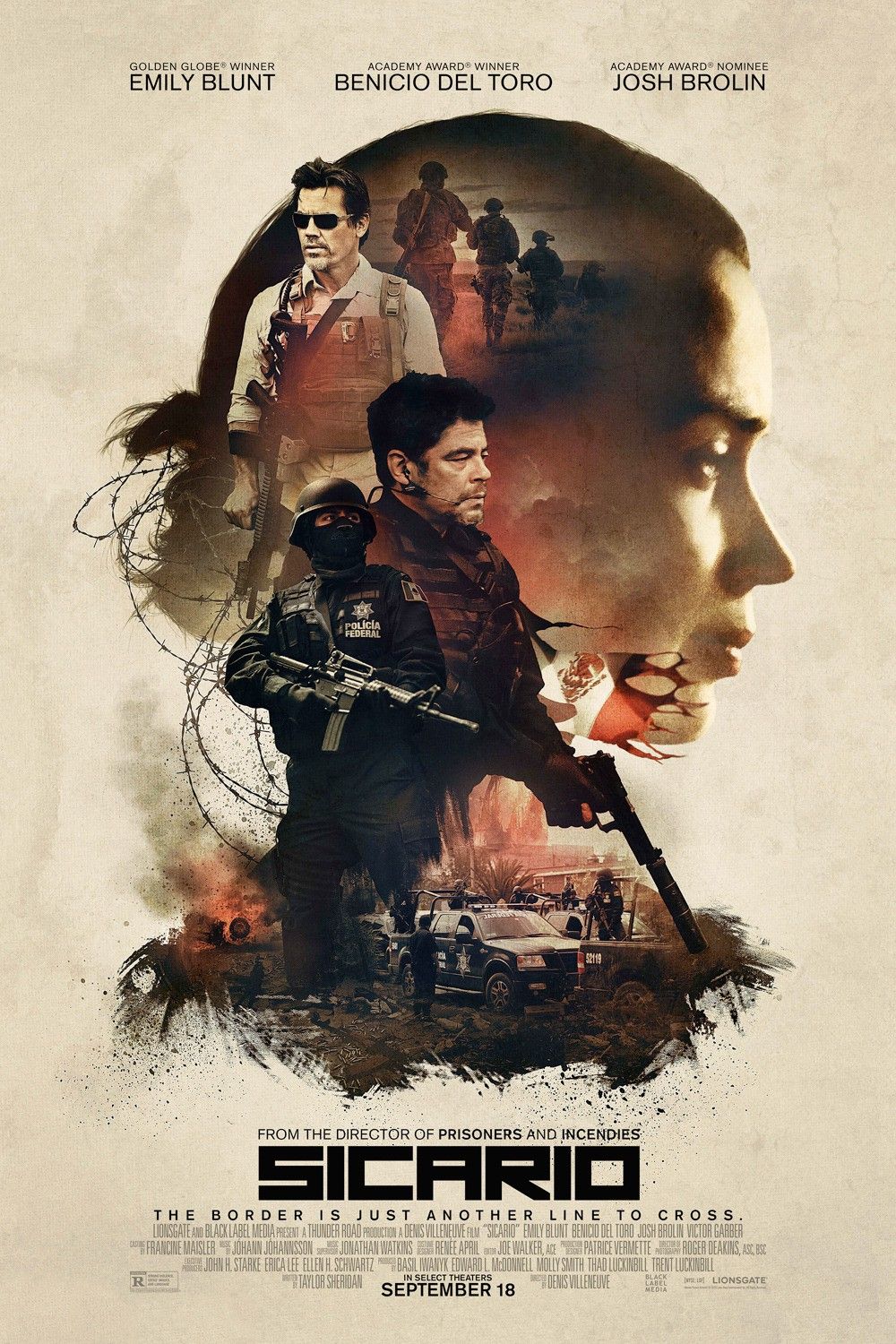
Sicario

Sicario follows FBI agent Kate Macer as she joins a team of Delta Force operators who are attempting to hunt down the people in charge of a Mexican drug cartels. Led by an adviser for the Department of Justice, Matt Graver, they begin operations in Mexico in order to draw the leader of the cartel back into Mexico. No more than about half an hour or so into Sicario we find our main characters on a mission to retrieve someone from a Mexican prison and transport them back to America. Everything has gone smoothly picking him up, but on the way back to the border they notice someone following the convoy in order to report on their movements, and not long after they find out that the border crossing is backed up with traffic. Sitting in the traffic jam, they slowly notice cartel members in other cars, but the voice in their ears tell them that they can't engage until they are engaged - so they sit in their cars, waiting for the cartel to make the first move before an intense burst of gunfire and violence over a matter of seconds concludes the confrontation. It's the kind of scene that leaves you breathless, a master class in building tension that makes you think 'Wow. Nothing this film can do from now on can top that'.

Kate acts as our sole viewpoint throughout the majority of Sicario and like Kate, we end up unsure about why things are happening or what might happen next, but the mystery Sicario tries to create isn't intriguing enough to serve as a narrative and the eventual reveal is so inconsequential that I don't know why Sicario bothered to hide it from the audience in the first place.

Additionally (and I'm going to preface this by saying that it might just be me that feels this way), Kate as a character doesn't really have an effect on the way the film progresses, and that bores me. She has no agency within the story, partly due to the aforementioned way that she kind of has no idea what is going on throughout, but also because of the way that at the end of the day she is simply being used by the team for jurisdiction rights. The way that Sicario progresses is through things happening to her rather than her making things happen, and if I'm being honest I expected more from a film with Emily Blunt - with or without her, almost all of Sicario would have happened the way it did, to the point where it begins to feel like Sicario should have chosen a different main character.

The film is otherwise incredibly well made, with stellar performances from the entire cast, particularly Benicio Del Toro, gorgeous cinematography courtesy of Roger Deakins, and a handful of intense scenes. Director Villeneueve is worth keeping an eye on, someone who manages to blur the line between art house cinema styles and mainstream appeal incredibly effectively, and I'm looking forward to seeing what he does next. I wouldn't recommend Sicario to everyone but I enjoyed it for what it was.

Friday, 8 June 2018

Concussion

Concussion, the true story about one doctor’s discovery of CTE (chronic traumatic encephalopothy) among athletes in the NFL, is a film to be admired, if not loved. With performances from Will Smith as Dr. Bennet Omalu, and Gugu Mbatha-Raw as his wife Prema, the gripping narrative explores one man's fight to be understood and respected. Whilst at times the depiction of the public and corporate backlash Dr. Omalu endured is unsettling the film makes necessary steps towards shining a light on the power the NFL has over the nation and media. Director Peter Landesman’s interpretation of the NFL could be perceived as a harsh generalization of an organisation focused on making money above all else, but ultimately his film is directed towards the NFL with with aim of making further changes in their regime. And sometimes, a jarring portrayal is more effective than an attempt to keep both sides happy.

From staged news conferences and phony medical advice to enlisting the F.B.I. to investigate his superior and friend Dr. Cyril Wecht, played by Albert Brooks, the National Football League sought to undermine Dr. Omalu and his colleagues, discredit the existence of CTE, and downplay the deadly nature of concussions. It would sound like a conspiracy theory if it weren’t all true. Brooks lends his signature sense of humor to the role of Wecht, a man who backs up Bennet’s crusade every step of the way, even when wary of the inevitable consequences. Despite a hit or miss southern accent, Alec Baldwin is especially effective as Dr. Julian Bailes, a former team doctor for the Steelers and an unlikely friend in helping Omalu combat these mounting obstacles. Smith gives his best performance in years as Omalu, a forensic pathologist at the Pittsburgh coroner’s office whose work is almost undone from the beginning when Steelers legend Mike Webster, played by David Morse, arrives in the lab. He is considered Patient Zero, the first known death due to CTE, and Omalu’s co-worker nearly derails the whole autopsy on the misguided basis of respecting his hero’s body. 


The pace of the film was at times confusing. Landesman moves things along a little too fast, utilizing overly kinetic cinematography and tired visual tricks to add immediacy to a story that’s already ripped from the headlines. Fake zooms, hokey freeze-frames, and CGI renditions of real-time concussions only distract and potentially undercut the message he is trying to convey. It’s not dissimilar from the sensationalist editing techniques found in Discovery channel crime documentaries. They might be eye-grabbing to some, but they render everything less authentic in the process. It’s important that Concussion preaches to more than the choir, and while occasionally amateur direction gets in the way of that, Will Smith’s commanding presence and a true story that’s hard to deny ensure this film succeeds in doing so.